Have you ever wondered who will set the pace of the digital future?
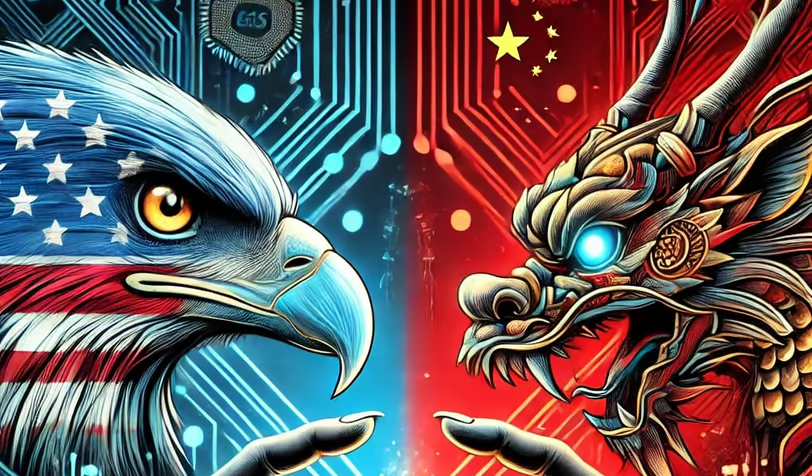
In a world where technology is the new currency, the United States and the China They face off in a battle that goes beyond computers: it is a true digital Cold War. On one side, we have the colossal project Stargate from the USA, a $500 billion investment aimed at building supercentrals for the Artificial intelligence. On the other hand, the China Bets on efficient innovation with DeepSeek – a model that, thanks to its open-source approach and lower energy consumption, is shaking Silicon Valley. And that's just the tip of the iceberg, because this rivalry also has implications in the world of Cryptocurrencies, the geopolitics and even in the management of day-to-day data. Ready to learn all the details?
Project Stargate: the colossal US response
The United States has put its cards on the table with the Project Stargate, an initiative that seeks to boost the infrastructure of the artificial intelligence on an unprecedented scale.
Huge Investment: It is estimated that up to $500 billion will be allocated to erect large data centres (the “supercomputing hubs”) capable of processing and training AI systems.
Principal Actors: Tech giants such as OpenAI(Chat GTP), Oracle i SoftBank They are joined by the political support of prominent figures.
Technology and Strategy: It is a bet on the brute force computational – that is, using a large amount of physical and energy resources to achieve high performance.
This model of mega-investment seeks to consolidate North American technological leadership, although it entails significant challenges in terms of dependence on strategic components, such as chips manufactured in countries like Taiwan.
China's efficient response: DeepSeek
While the USA bets on size, China shows that a lot can be achieved with little. The platform DeepSeek It is the perfect example of this disruptive innovation strategy.
Energy and Economic Efficiency: Instead of investing in high-end components, DeepSeek uses more affordable technology, maintaining high performance with much lower energy consumption.
Open Source and Transparency: This model, released as open source, allows anyone to review, improve and customise the software, opening the door to global collaboration.
Impact on the Market: DeepSeek's innovation has shaken the sector, even causing sharp movements in the value of companies such as Nvidia.
This approach not only highlights China's adaptability and efficiency, but also offers an attractive alternative for companies with tighter budgets.
The digital cold war: AI, crypto and geopolitics
Current technological competition is not limited to just the artificial intelligence. There is also an intense struggle in other areas:
Geopolitics: The rivalry between the United States of America and China is reflected in protectionist trade policies and in the management of supply chains, especially in critical sectors such as chip manufacturing.
Cryptocurrencies and Blockchain: The fusion of blockchain technology with the Artificial intelligence It opens up new opportunities in security and data management, with a direct impact on the global economy.
Global repercussions: This “digital cold war” could lead to the creation of economic blocs or “technological walls”, in which countries are divided according to their capacity to innovate and manage technological resources.
Thus, rather than a mere race to have the best AI system, it is about defining who will control the rules of the digital future.
Risks, debates and future perspectives
However attractive mega-investment or efficient innovation may seem, they are not without their critics:
Economic Viability: There are voices questioning whether it is prudent to allocate such sums solely to boost computational power, suggesting that it might be better to invest in algorithm optimisation.
Component Dependency: The concentration on advanced chips, especially manufactured in Taiwan, generates a geopolitical risk in the event of a conflict.
Concentration of Power: Such a massive investment could lead to only a few players controlling the market, limiting competition and innovation.
Social Impact: Beyond the economic aspects, these projects generate debate about privacy, security and ethics in the use of the Artificial intelligence.
These issues open up a necessary debate about which model is truly sustainable in the long term.
Brief comparison: ChatGPT vs. DeepSeek (Bonus Point)
Although our analysis focuses on geopolitical rivalry and global implications, it is interesting to highlight, as a point, that models such as ChatGPT i DeepSeek represent two very different visions of the Artificial intelligence. While ChatGPT operates primarily through cloud-based services and offers a centralised experience, DeepSeek opts for flexibility and privacy with local execution (even running on your PC without an internet connection). This distinction not only affects technological competitiveness but also how data is managed in an increasingly connected global environment.
Conclusion: what will be the engine of the digital future?
Ultimately, the battle for technological supremacy between the United States and China is much more than a simple race to have the most powerful AI systems. It is a struggle to define the future of our economy, our security and our way of life.
USA and the Megainvestment Model: With its Project Stargate, bets on a colossal physical infrastructure.
China and Efficient Innovation: With DeepSeek, demonstrates that efficient innovation can be equally revolutionary.
The Digital Cold War: The integration of the Artificial intelligence with other technologies such as cryptocurrencies and blockchain redrawing the rules of the game on a global level.
The big question is: Who will be the true driving force of the digital future? The answer does not depend solely on financial investment, but on the ability to adapt and innovate in a constantly evolving world.
Bibliography and sources
From Wikipedia: Information about Project Stargate and associated risks.
ELPAIS.COM: Analysis and description of the Chinese response with DeepSeek.
British Wikipedia: Details about the global competition in Artificial intelligence and geopolitics.
Spanish Wikipedia: Information on the merger between Artificial intelligence, cryptocurrencies and trade policy.
Recommended Articles for Further Reading