Silicon Valley and Trump's politics
Silicon Valley, the heart of technological innovation, has always been known for its progressive stance on issues such as diversity, the environment and digital privacy. But when it comes to politics, the major tech companies have shown a leaning towards Republican policies, especially during Donald Trump's presidency. This article analyses the reasons for this relationship between tech companies and Trump, and how, despite public criticism, his policies have been more beneficial to them than those of Joe Biden.
Less regulation, more profit
The benefit of deregulation
During Trump's term in office, one of his main priorities was to reduce business regulation. This allowed big tech companies to operate with more freedom, without the restrictions imposed by the Biden administration. Tax cuts and a softer stance on antitrust laws facilitated greater profits for giants such as Google, Amazon and Meta. More freedom to innovate and expand, without limits to curb their growth.
to Biden's opposition
With Biden's arrival, large companies have faced increased regulation on data protection and competition oversight. For Silicon Valley, this represents an obstacle to maintaining the rapid growth that characterised the Trump years.
AI without ties
Technology companies and the freedom to innovate
Tech companies see excessive regulation as a barrier to innovation, especially in the field of artificial intelligence (AI). The Trump administration was characterised by a more relaxed stance on AI controls, unlike Biden's regulatory proposals. This allowed companies such as OpenAI, Google and Nvidia to develop new technologies with fewer restrictions.
Biden vs. Trump's stance
Biden, by contrast, wanted to introduce regulations to govern the use of AI and its application across various fields. This caused some concern in Silicon Valley, where companies seek the freedom to innovate without constraints that could halt their technological progress.
Competition with China and the global market
The trade war and the benefits for Silicon Valley
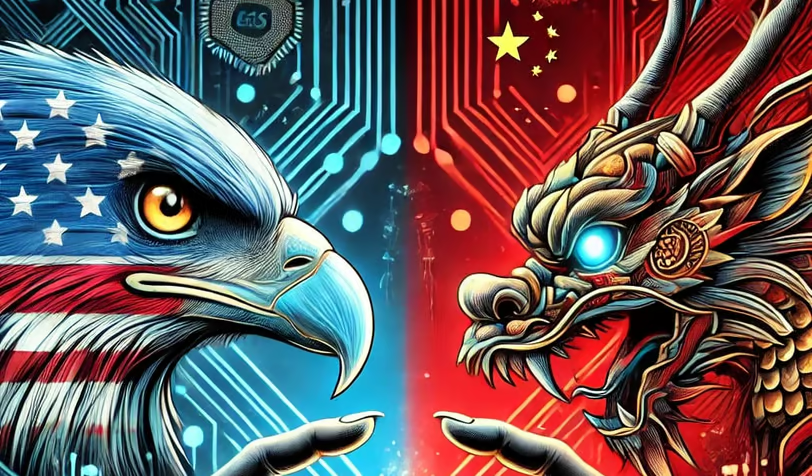
Trump promoted a tough stance against China, imposing tariffs and sanctions on companies such as Huawei. These measures, while affecting certain firms like Apple, benefited others, such as Intel and AMD, which saw their Chinese competition reduced in the global market. The sanctions against Huawei and other Chinese companies allowed American giants to expand into key regions.
Incentives for local production
With the need to reduce dependence on China, Trump also provided incentives for microchip production in the US, which was seen as an opportunity by some major Silicon Valley tech companies to gain market share and cut costs.
Trump vs. Silicon Valley: a love-hate relationship
The conflict of public interests
Despite Trump's public criticism of Silicon Valley, particularly regarding the censorship of conservative voices on social media, the reality is that his policies clearly favoured the big tech companies. These contradictions are common in the business world: companies seek economic advantage over political differences. Republican policies, despite being criticised by some companies, proved far more favourable to the tech sector compared to Biden's more regulatory stance.
Conclusion: Money rules over ideology
Although Silicon Valley maintains a left-wing image, the truth is that the major tech companies prioritise economic profits over any ideology. Support for Trump, despite the criticism many leaders in this sector have directed at him, reflects the industry's pragmatism. Trump's policies, centred on deregulation, tax cuts and the expansion of global opportunities, were seen as a positive change for the major tech companies. It is likely that, had he remained in power, Silicon Valley would have continued to prosper thanks to these factors.
Recommendations for further reading
The New York Times – Why Silicon Valley and Washington Are at Odds
Bloomberg – Tech Companies and Trump: A Complex Relationship
Axios – Tech Giants and Politics: The Legacy of the Trump Era
MIT Technology Review – Big Tech and Trump: Understanding the Complex Relationship
Business Insider – The Trump Effect on Big Tech: A New Business Era
Politico – How Silicon Valley's Politics Are Shifting in the Trump Era
The Techno-Dork – Silicon Valley and Trump's impact on the tech industry
Sources used
Bradford, A. (2020), The Brussels Effect: How the European Union Rules the World. Oxford University Press.
Madiega, T. (2022). Artificial Intelligence Act: EU Legislation in Progress. European Parliamentary Research Service.
Pelkmans, J., & Renda, A. (2014). Does EU Regulation Hinder or Stimulate Innovation? Centre for European Policy Studies (CEPS).
Five Days (2025). Ericsson and Nokia call for measures to save Europe's technological future.
Bradford, A., & Chander, A. (2022). The Brussels Effect and Artificial Intelligence: How EU Regulation Will Impact the Global AI Market.
The Wall Street Journal, The Washington Post, CNBC, Forbes, Plazzi